Visits by appointment only - please call 07976 531152 to arrange.

Red Mite in Chickens – How to Find, Treat and Prevent It
How to find, kill and prevent infestations before they start.
PESTS AND PREDATORS
Sarah Barratt
A red mite infestation is one of the biggest nightmares any chicken keeper will ever face. If you keep hens long enough, chances are you will come across it at some point. The problem with red mite is that it often starts very quietly. You might notice your hens are slightly unsettled at night, egg production dips a little, or they seem reluctant to go into the coop. By the time you actually see the mites, the infestation can already be well established.
Red mite, or Dermanyssus gallinae, is a tiny blood-sucking parasite that feeds on chickens during the night. During the day the mites hide away in cracks, crevices, perch ends, nest boxes and tiny gaps inside the coop. They are incredibly small, usually grey when unfed, but after feeding on blood they turn dark red, which is where the name comes from.
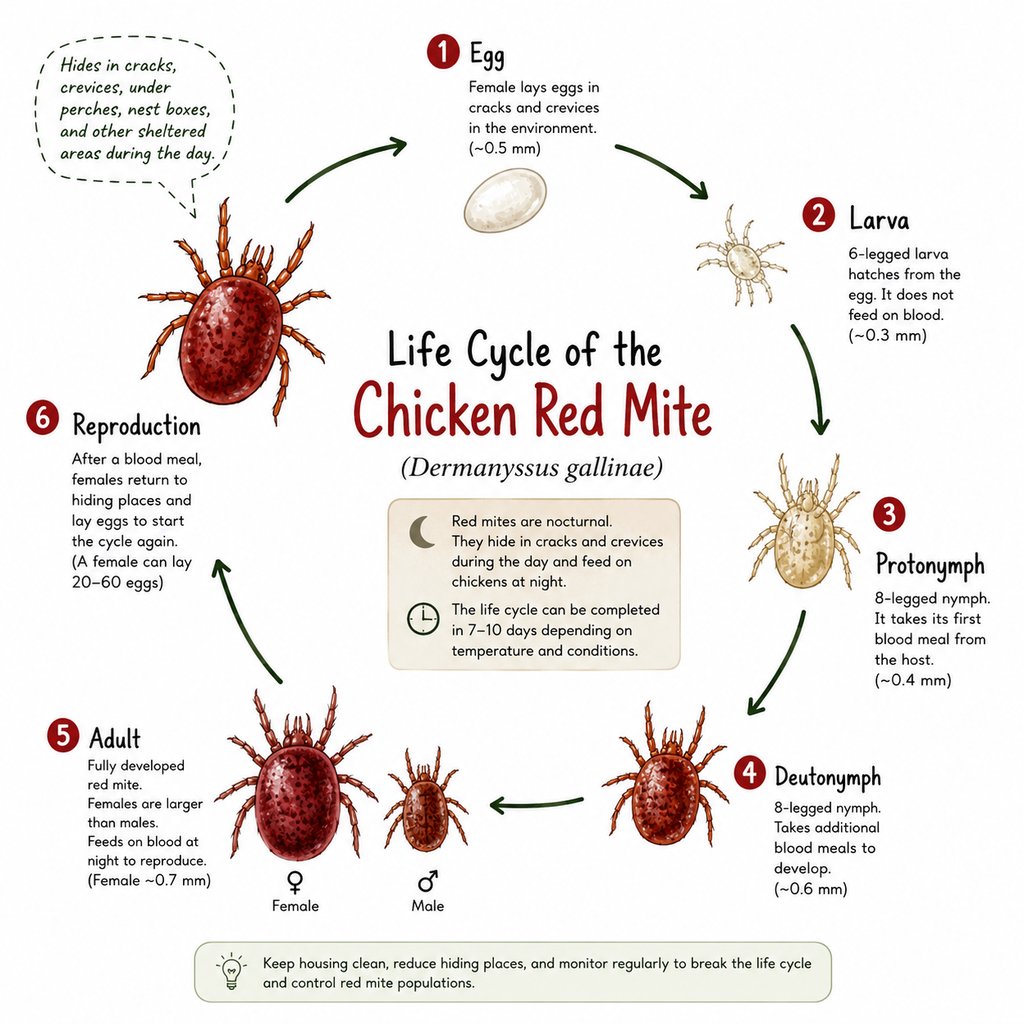
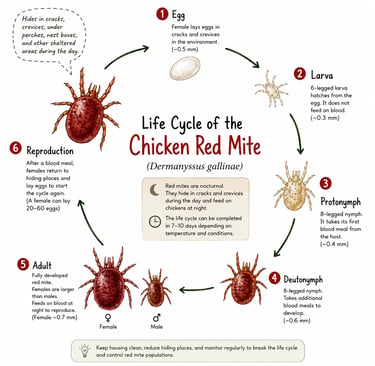
One of the reasons red mite is so difficult to control is because of its life cycle. Under warm conditions the entire cycle from egg to adult can take as little as seven to ten days. That means numbers can explode very quickly during warm weather. A few mites hidden in a crack can turn into tens of thousands before you even realise there is a problem.
The life cycle starts with eggs hidden deep inside cracks and joints in the coop. The eggs hatch into larvae which do not feed initially, but after moulting into nymph stages they begin feeding on the hens’ blood. The adult mites then continue the cycle by laying even more eggs. Because they spend most of their lives hidden away in the coop rather than living directly on the bird, treating the hens alone rarely solves the problem. The environment itself must be treated thoroughly.
Red mite is always at its worst during the warmer months, particularly from late spring through summer and into early autumn. Warm temperatures and humidity allow the mites to breed rapidly. In winter they often seem to disappear, but they are usually still there hiding dormant inside the coop waiting for warmer weather to return. Some studies suggest they can survive many months without feeding.
The effect on hens can be devastating. Every night the mites emerge to feed on the birds’ blood while they sleep. A light infestation may simply cause irritation, stress and feather pecking. Hens become restless and uncomfortable, often refusing to perch or even refusing to enter the coop altogether because they know something is attacking them during the night. You may notice them scratching constantly or looking miserable and tired.
As the infestation grows, the blood loss becomes more serious. The hens develop anaemia, which shows as pale combs and wattles. Egg production drops because the hens are stressed and weakened. Many keepers notice their once reliable layers suddenly slowing down or stopping altogether. The birds lose condition, lose weight and stop thriving. In severe infestations the blood loss can become so extreme that hens die from exhaustion and anaemia. Sadly, this happens more often than many people realise.
People often ask where red mites come from in the first place. Unfortunately they can arrive from many sources. Wild birds are a common cause because they carry mites from place to place. New hens brought into the flock can introduce them. Second-hand coops, feeders, perches and equipment are another major source. Even clothing, egg trays and bedding can transport mites from one place to another. Once they arrive, they quickly establish themselves if conditions are right.
One thing many people do not realise is how much bedding choice can contribute to the problem. Straw and hay might look traditional and cosy in nest boxes, but the hollow tubular stalks create perfect hiding places for mites and their eggs. The mites crawl inside the stalks where sprays and powders struggle to reach them. This is one reason infestations can become persistent. Many experienced keepers now prefer alternatives that are less attractive to mites and easier to clean regularly.
The type of coop you use also makes a huge difference. Wooden houses may look lovely, but from a red mite point of view they are almost the perfect home. Wood naturally expands, contracts and cracks over time, creating endless tiny hiding places. Mites hide deep inside joints, screw holes, knots in the timber and under roofing felt where treatments often cannot penetrate properly. This is why infestations in wooden houses can become almost impossible to eliminate completely.
Plastic houses are generally far easier to manage when it comes to red mite. Smooth plastic surfaces provide far fewer hiding places, and most plastic coops can be dismantled into sections. This means the whole house can be taken apart and jet washed thoroughly over a main drain, flushing huge numbers of mites and eggs away very effectively. A good pressure wash followed by treatment with products such as Smite Professional can make a massive difference. Many keepers who switch from wood to plastic say they would never go back.
The key with red mite is prevention. Once an infestation takes hold, it becomes incredibly difficult to regain control. Checking the coop every single week is one of the best habits any chicken keeper can develop. Pay particular attention to perch ends, corners, nest boxes and cracks. Running a white tissue or cloth along the edges can reveal red smears if mites are present after feeding.
Regular spraying with products such as Smite Professional can help keep numbers under control before they explode. Smite works well as part of a preventative routine because it targets the coop environment where the mites live. Many keepers also use products like Total Mite Stop, Dergall, Per Bio Choc, Creosote and lime-based disinfectants as part of their cleaning routine. Different products work in different ways, some physically damaging the mites while others disinfect and reduce the environment they thrive in.
Diatomaceous earth is another popular product and is widely used in nest boxes, dust baths and around perch areas. It works by damaging the outer coating of the mites, causing them to dehydrate. Many people swear by it as part of a prevention plan, especially when used regularly in dry conditions. However, it is important to use it carefully because the dust can irritate lungs if overused. I personally do not recommend this as a method of control as have found it to be completely ineffective.
For severe infestations many poultry keepers eventually turn to Exzolt. Exzolt is often regarded as the most effective treatment available because it works systemically through the hens’ blood, meaning the mites die when they feed. People who have battled massive infestations often describe Exzolt as the only thing that finally broke the cycle when everything else failed. The reality is that once a coop is heavily infested, especially a wooden one, it can feel almost impossible to completely eradicate the mites without using something as powerful as Exzolt. You would need to obtain this from your vet as it is a POM meaning you need a visit, a prescription and then to purchase the product. It is expensive but you need a very small amount. 0.05ml for each kilo of bird which is repeated a week later.
This is why being proactive is always better than being reactive. A quick weekly inspection and preventative spray takes minutes. Trying to deal with a full-scale infestation can take weeks or months and can become emotionally exhausting as well as expensive. Some people end up replacing entire coops or even burning old wooden houses because the mites have become so deeply embedded in the structure.
Red mite is unfortunately part of chicken keeping, but it does not have to become a disaster. Cleanliness, vigilance and regular prevention are the real secret. If you stay one step ahead of them, your hens will stay healthy, productive and happy. Ignore the warning signs, however, and red mite can rapidly take over a coop and seriously damage the health and wellbeing of your flock.
© 2026. All rights reserved.
Contact
07976 531152
info@parksidepoultry.uk
Useful Links
Address
4 Croft Road, Aldershot, Hampshire. GU11 3HR