Visits by appointment only - please call 07976 531152 to arrange.
Understanding Feather Type
Smooth, silkied and frizzle feathers explained. Why feathers differ and how to breed for a certain feather type, which to cross and which crosses to avoid.
GENETICS
Sarah Barratt
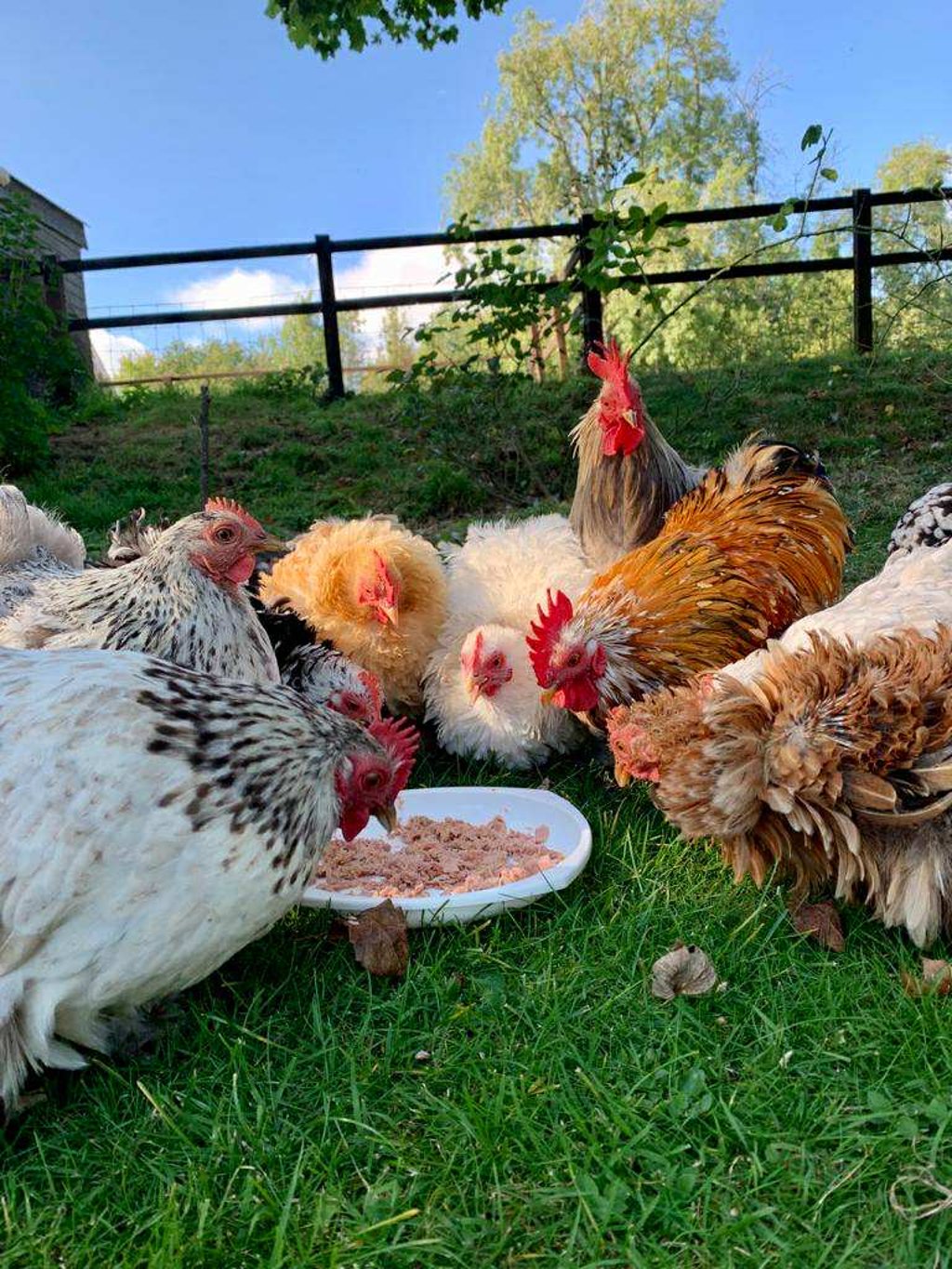
Chickens have several feather types that are controlled by specific genes. The three mentioned—normal, frizzle, and silkied—are among the best understood. Their inheritance patterns differ, making some much easier to produce consistently than others.
1. Normal Feathering
Normal feathering is considered the "wild type" or standard feather structure.
Genetics
Gene: Normal allele at the frizzle locus (fr+) and normal allele at the silkie locus (H).
Normal feathering is dominant over silkie feathering simply because silkie requires two recessive alleles.
At the frizzle locus, normal is recessive to a single frizzle allele but dominant over the absence of a frizzle phenotype.
If we simplify:
TraitGenotypeNormal (not frizzled)fr+/fr+Normal (silkie locus)H/H or H/h
A bird can carry silkie without showing it.
2. Frizzle Feathering
Frizzle feathers curl outward instead of lying flat against the body.
Genetics
The frizzle gene (F) is incompletely dominant.
GenotypeAppearancef+/f+NormalF/f+Frizzle (ideal)F/FExtreme frizzle ("curl" or "frazzle")
Important point
The homozygous form (F/F) is generally undesirable.
These birds often have:
brittle feathers
sparse feather coverage
difficulty regulating body temperature
reduced show quality
For this reason, responsible breeders usually avoid producing F/F birds.
Reliable breeding
Best cross
Frizzle × Normal
F/f+ × f+/f+
Produces:
50% Frizzle
50% Normal
No frazzles.
This is the standard recommendation.
Frizzle × Frizzle
F/f+ × F/f+
Produces
25% Normal
50% Frizzle
25% Frazzle
Because one-quarter of chicks are expected to be frazzled, this mating is generally avoided.
3. Silkie Feathering
Silkie feathers lack the tiny hooklets (barbicels) that normally zip the feather together.
Instead of forming a flat vane, the feather separates into soft fibers, producing the fluffy appearance.
Genetics
The Silkie gene (h) is recessive.
GenotypeAppearanceH/HNormalH/hNormal carrierh/hSilkied
Only birds with h/h express the trait.
Reliable breeding
Silkie × Silkie
h/h × h/h
Produces
100% Silkied
This is the only way to guarantee every chick is silkied.
Carrier × Carrier
H/h × H/h
Produces
25% Normal
50% Carrier
25% Silkied
Silkie × Carrier
h/h × H/h
Produces
50% Silkied
50% Carrier
Silkie × Normal (non-carrier)
h/h × H/H
Produces
100% Carriers
0% Silkied
Combining Frizzle and Silkie
The two genes assort independently.
A bird can therefore be:
normal
frizzled
silkied
frizzled silkie
A frizzled silkie has fluffy feathers that also curl outward.
Example
Suppose:
Parent 1
F/f+ h/h
Parent 2
f+/f+ h/h
Offspring
50% Frizzled Silkies
50% Normal-feathered Silkies
This is commonly used because it avoids producing frazzles while maintaining the silkie feather type.
Summary of Inheritance
TraitGeneInheritanceHomozygous effectNormalWild type—Standard featherFrizzleFIncompletely dominantF/F gives excessive curling ("frazzle")SilkiehRecessiveh/h gives silkied feathers
Breeding Strategies
GoalRecommended matingExpected result100% NormalNormal × NormalAll normal50% FrizzleFrizzle × Normal50% frizzle, 50% normal100% SilkieSilkie × SilkieAll silkied50% SilkieSilkie × CarrierHalf silkiedFrizzled SilkiesFrizzled Silkie × Normal-feathered Silkie50% frizzled silkies, 50% normal silkies
Notes on Other Feather-Modifying Genes
Frizzle and silkie are only two of many genes affecting feather structure. Others include:
Naked Neck (Na): Dominant; reduces feathering on the neck.
Scaleless (sc): Recessive; causes near-complete absence of feathers.
Crest (Cr): Dominant; produces a crest of feathers on the head.
Muffs and Beard (Mb): Dominant; produces facial feathering.
Feathered Legs (multiple loci): Polygenic with major-effect genes influencing shank and toe feathering.
In practical breeding, maintaining separate lines—for example, a high-quality frizzle line (heterozygous F/f+) and a normal-feathered line, or a pure silkie (h/h) line and a carrier line—allows breeders to produce predictable proportions of the desired feather type while avoiding undesirable genotypes such as F/F frazzles.
© 2026. All rights reserved.
Contact
07976 531152
info@parksidepoultry.uk
Useful Links
Address
4 Croft Road, Aldershot, Hampshire. GU11 3HR